
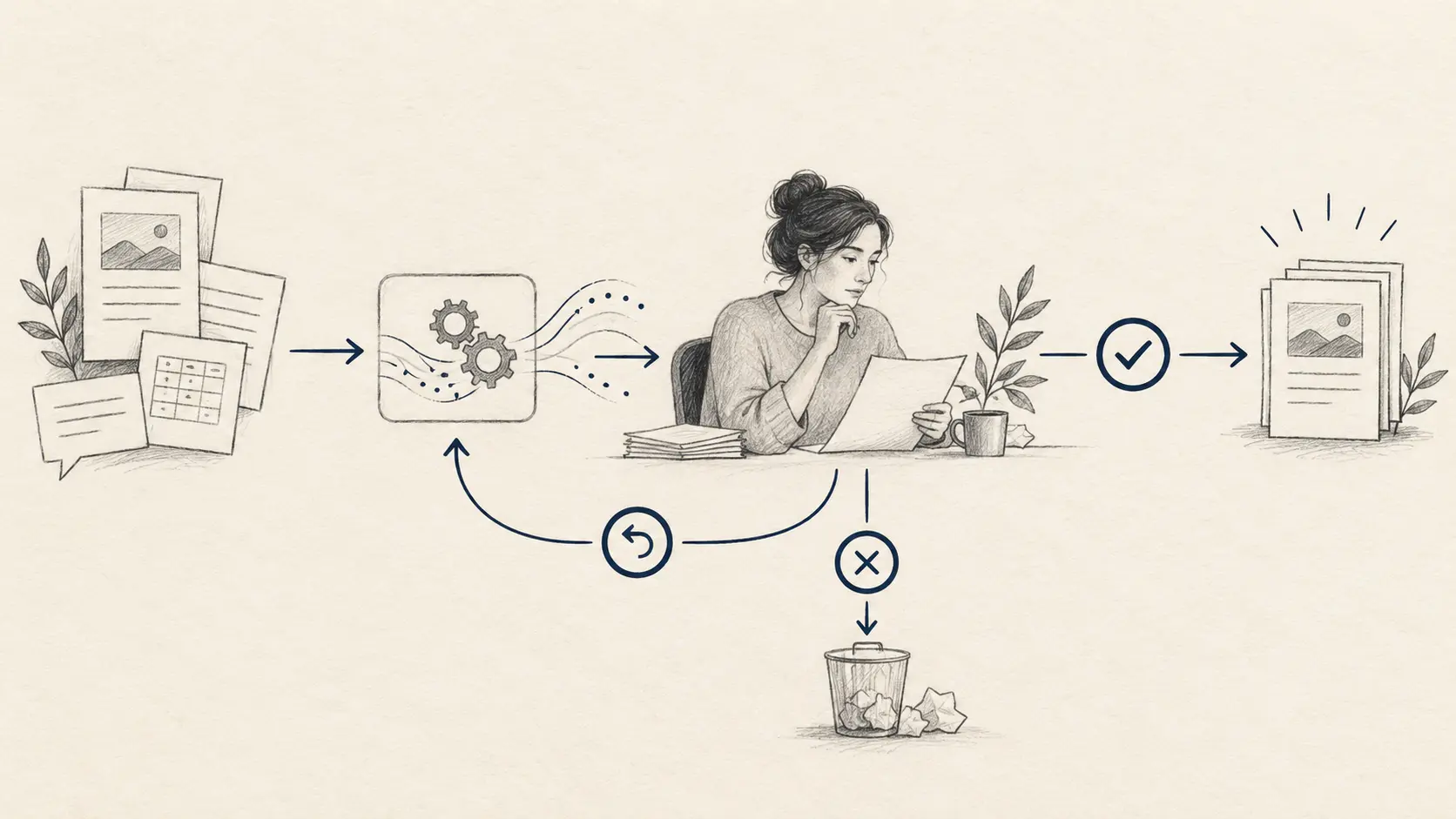
Human review is often presented as a universal answer to AI risk: let the model prepare the work, then have a person check it. That sounds responsible, but it leaves the most important design question unanswered. What exactly should the person review, and what are they able to do when something looks wrong?
A review step can protect a workflow. It can also become a queue where people approve plausible-looking output under time pressure. The aim is not to place a human beside every model call. It is to keep meaningful judgement and authority at the points where an error could matter.
A person in the loop is not automatically a safeguard
For review to be real, the reviewer needs enough context to recognise a problem, enough time to investigate it and explicit authority to return, correct or stop the result. A bare approval button beside a fluent AI answer provides none of those things.
Human oversight is effective only when the person can understand the decision point and change what happens next.
The Australian Government’s Digital Transformation Agency makes the same distinction in its June 2026 guidance for more autonomous AI systems: different use cases require different levels of control, with monitoring and mechanisms to intervene, pause or safely stop activity. Read the DTA guidance published 4 June 2026.
Five questions determine the level of review
- 01
What is the consequence of a wrong result?
A rough internal summary and a message sent to a customer do not deserve the same control. Consider financial loss, privacy, reputation, safety, legal effect and the burden placed on the person affected.
- 02
Can the action be reversed?
A draft can be deleted. A published claim, payment, account change or disclosure may be difficult to retrieve. Review should move earlier as reversibility decreases.
- 03
Can a reviewer verify the result?
Review is useful when the source, rule or comparison is visible. It is weak when the person must trust the same opaque output they are meant to check.
- 04
Does the workflow use sensitive information or affect a person?
Personal, confidential or consequential information raises the need for access controls, clear purpose, accuracy checks and a genuine path for human correction.
- 05
How much authority does the AI have?
Suggesting text is different from changing a record, contacting someone or triggering another system. The more the AI can act, the stronger the permissions, approval boundaries and stop controls should be.
Use a four-level control ladder
Sample and monitor
Low-consequence, reversible output can proceed without individual approval when quality is measured, samples are reviewed and problems can be corrected quickly.
Review exceptions
Clear rules handle normal cases while unusual, incomplete or uncertain cases go to a person. The exception criteria must be observable and tested.
Approve before action
A person checks the proposed result before it is sent, published, committed or used to change a record. The reviewer sees sources and can reject or edit it.
Keep the decision human
AI may organise evidence or prepare a draft, but it does not make the consequential judgement. Use this boundary when impact is high or verification is weak.
This is not a maturity ladder where every system should move towards more autonomy. Level four can be the most sensible permanent design. Level one can be responsible when the use is genuinely low-risk and well observed.
Design the review, not just the model
A reviewer should be able to see
- The source information used.
- What the AI changed or inferred.
- Missing, conflicting or uncertain inputs.
- The action that approval will trigger.
- Relevant history and prior corrections.
A reviewer should be able to do
- Approve, edit, return or reject.
- Escalate an unfamiliar case.
- Stop or pause the workflow.
- Record why an exception occurred.
- Restore a safe manual path.
These controls belong in the workflow and interface, not only in a policy document. If approving is effortless but finding the source takes several screens, the design encourages speed rather than judgement.
Review should follow risk, not volume
Reviewing everything can make a system less safe. High volumes produce fatigue and routine approval. Reserve attention for consequential actions, exceptions and samples that can reveal drift.
Confidence scores do not replace verification. A model can be confident and wrong. Use uncertainty as one signal, alongside missing information, rule conflicts, unusual values and the real-world consequence of the action.
A disclaimer is not a control. Telling users that AI can make mistakes does not prevent a wrong output from changing a record or affecting a person.
Human review is not always enough. If the reviewer lacks subject knowledge, cannot inspect the evidence or is not allowed to overturn the result, narrow the AI’s role or do not use it for that decision.
Privacy and accuracy can change the boundary
The Office of the Australian Information Commissioner advises organisations using commercial AI products to consider how human oversight is embedded, who can access personal information and whether a product is appropriate for its intended use. It also recommends ongoing monitoring rather than a “set and forget” approach. See the OAIC guidance, updated 21 October 2024.
Where AI output contains personal information or contributes to a decision about a person, the OAIC says a human should be responsible for verifying accuracy and able to overturn decisions. That is a stronger standard than simply looking at the output before it moves on.
Three examples at different scales
Personal information workflow: AI suggests tags for private notes. Incorrect tags are reversible, so sample review and a simple correction path may be enough. Sharing a note externally should remain a separate, explicit action.
Professional process: AI prepares a client email from verified matter information. The practitioner sees the source fields and approves the message before sending. Missing or conflicting details block the draft rather than inviting the model to guess.
Organisational workflow: AI extracts information from incoming documents and proposes a case status. Deterministic validation handles required fields, unusual cases go to trained staff, and any decision materially affecting a person remains with an accountable human.
Test the control path as seriously as the AI output
Use representative cases, including incomplete inputs and plausible errors. Check whether reviewers notice the problem, whether they understand the consequence of approval, and whether stopping or returning the work actually leaves the system in a safe state.
Then watch the workflow after launch. Measure corrections, overrides, missed exceptions and patterns of automatic approval. If reviewers stop challenging output, the answer may not be more training; the review step itself may need to be redesigned.
If AI has not yet earned a place in the workflow, begin with the test for whether the problem needs AI. If the workflow itself is still unclear, use the automation readiness framework before deciding where review belongs.
The decision
Put human judgement where it can change the outcome.
Match review to consequence, reversibility, verifiability, information sensitivity and AI authority. Give reviewers evidence, time and a real ability to intervene. Then monitor whether the control works in practice — not merely whether a person’s name appears beside it.
Discuss a reliable AI workflowOr explore UZENA’s AI workflow, automation and reliability services.