
Many AI conversations begin too late in the decision process. A team sees a demonstration, hears about a new model or notices a competitor using an AI feature. The discussion quickly becomes about products, licences and integrations before anyone has clearly described what should become better.
That order creates an avoidable risk: a technically impressive system that does not solve an important business problem. AI should earn its place in a solution. It should not receive a place simply because it is available.
Begin with the outcome, not the technology
A useful project starts with an observable change. Perhaps enquiries take too long to qualify, staff repeatedly assemble the same report, product information is inconsistent, or useful knowledge is trapped across documents and inboxes.
Describe that change without using the words “AI”, “chatbot” or “automation”. If the goal becomes unclear when those words are removed, the project is probably still an idea about technology rather than a defined business need.
“Use AI” is not an outcome. “Reduce the time required to prepare a reviewable first draft from two hours to twenty minutes” is an outcome.
Seven questions that reveal whether AI belongs
- 01
What would become meaningfully better?
Define the result in operational terms: less waiting, fewer repeated steps, better access to knowledge, more consistent decisions or a new capability that was previously impractical.
- 02
What kind of information does the work involve?
AI is most useful when inputs are difficult to express as fixed rules — language, images, audio, uncertain categories or patterns across many examples. Structured calculations and deterministic decisions usually belong in ordinary software.
- 03
Is there enough usable context?
A model cannot compensate for missing source material, contradictory policies or knowledge that exists only in someone’s memory. Organising information may be the first project.
- 04
Can a good result and a bad result be recognised?
If nobody can explain what acceptable output looks like, the system cannot be tested responsibly. Examples, evaluation criteria and clear boundaries matter more than an impressive demo.
- 05
What happens when the system is wrong?
Errors must have a proportionate response. A rough internal summary can be reviewed. An incorrect payment, safety instruction or public claim may require deterministic controls or human approval before any action occurs.
- 06
Where will human judgement remain?
Good automation does not remove judgement indiscriminately. It removes avoidable effort and presents people with clearer information, exceptions and decisions that deserve attention.
- 07
Does the business case survive after the novelty fades?
Include integration, review, maintenance, changing model behaviour and staff adoption — not only the price of an API call. If the continuing value does not justify the continuing responsibility, the project should remain small.
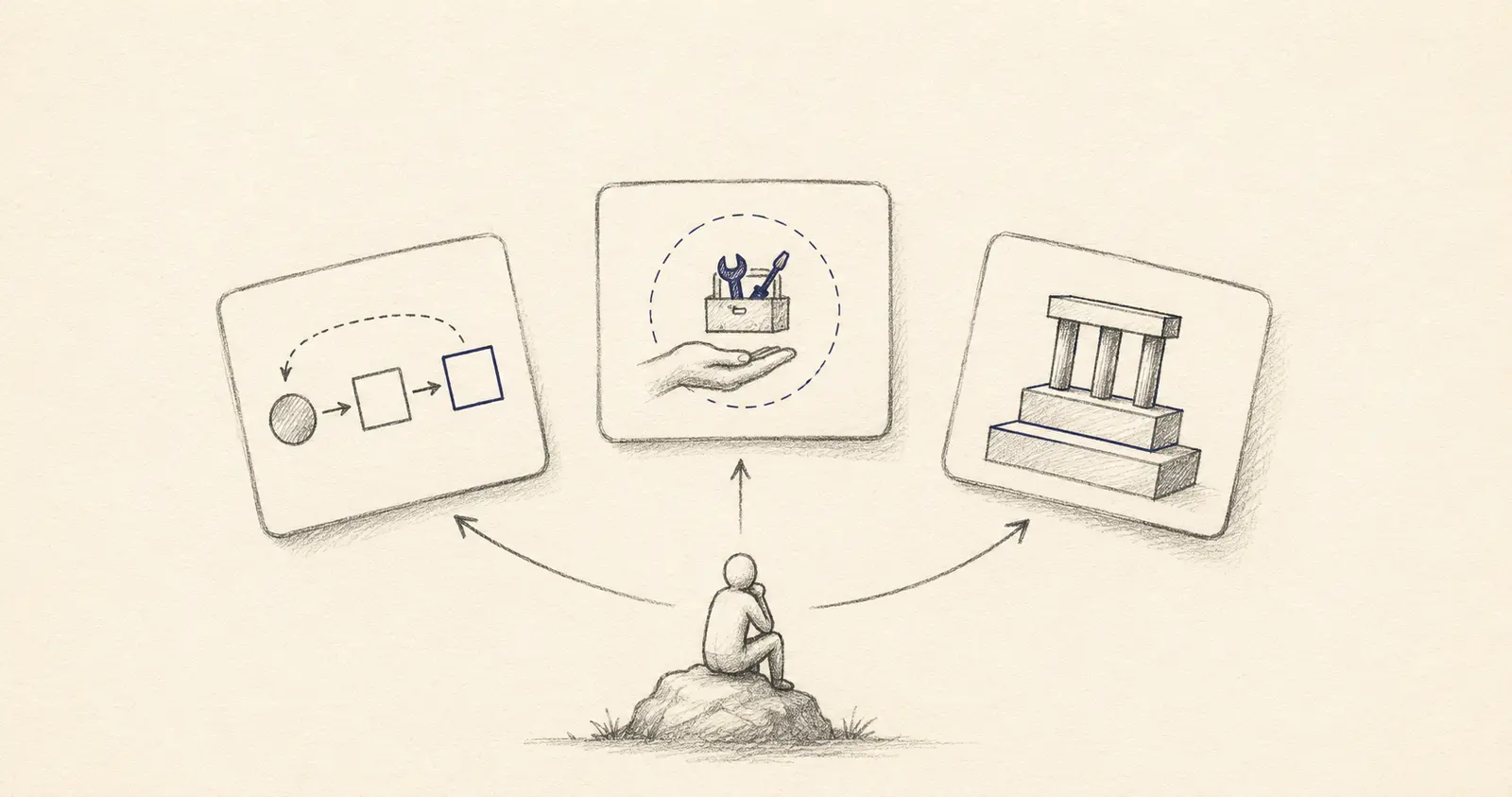
Three legitimate answers
Improve the process first
The problem comes from unclear ownership, duplicated information or unnecessary steps. Mapping and simplifying the workflow may create most of the value without AI.
Use AI as an assistant
AI drafts, classifies, extracts or suggests. Existing software, rules and people retain control over records, approvals and consequential decisions.
Make AI part of the capability
The desired outcome depends on interpreting unstructured information or operating at a scale that normal rules cannot manage. Evaluation, monitoring and fallback become part of the product.
Signs that AI may be useful
Promising signals
- People repeatedly read, compare, summarise or classify large amounts of unstructured information.
- The task contains variation that makes fixed templates brittle.
- A useful first draft has value even when a person must review it.
- There are enough examples to evaluate quality.
- Errors can be detected and contained before harm occurs.
Reasons to pause
- The underlying process has no clear owner or agreed outcome.
- Source information is missing, inaccessible or unreliable.
- The task is already expressible with stable rules.
- The volume is too low to justify ongoing complexity.
- A plausible-sounding error would be difficult to detect.
- The project only makes sense if the model is assumed to be perfect.
A practical example
Consider a business that prepares a weekly client report. Staff collect figures from several systems, copy them into a document and write a short explanation.
The calculation and transfer of known figures should remain deterministic. Software can gather the data, validate required fields and preserve the source. AI may help draft the narrative explanation, but only from the verified figures. A person reviews the wording before delivery.
The useful solution is therefore not “an AI report generator”. It is a controlled reporting workflow in which normal software protects the facts, AI assists with language and a human remains responsible for publication.
Start with the smallest useful experiment
A sensible first phase does not need to prove that AI can transform the whole business. It needs to answer a smaller set of questions: Can the necessary information be accessed? Can output quality be evaluated? Where do failures occur? How much review is required? Does the result save meaningful effort or improve an important outcome?
Run the experiment on representative work, including difficult cases — not only examples chosen because they make the technology look good. The result may justify a larger system, a narrower assistant, or no AI at all. All three are useful discoveries.
If the experiment proceeds, use the human review control framework to decide which outputs can be sampled, which exceptions need attention and which actions require approval before they occur.
The decision
AI should be the result of understanding, not the substitute for it.
The strongest solution may combine workflow redesign, ordinary software, structured data, clear controls and a carefully bounded role for AI. Begin by making the problem and the desired change visible. The right technology becomes much easier to choose after that.
Tell us what you’re trying to improve